

Thailand's Two Rainy Seasons: Why Koh Samui Is Soaked in November
This material was prepared with the help of artificial intelligence and checked by a person. Editorial responsibility: Aster Of Asia Co., Ltd..
Responsible for content: Leonid Ustinov, Aster Of Asia Co., Ltd.
Aster of Asia editorial team
Thailand does not have one rainy season, it has two, and they do not line up. On the Andaman coast (Phuket, Krabi, Khao Lak) it is wet from mid-May to mid-October, with the peak in September. On Koh Samui, Koh Phangan and Koh Tao it is the other way around: the wettest month is November, and the dry stretch runs roughly from February to August.
For travellers and property buyers who plan to spend real time on the islands, knowing which coast is wet when matters as much as the headline rainfall figures.
Why the two coasts get rain in different months
The cause is two monsoons. From mid-May to October the southwest monsoon blows in, carrying moisture from the Indian Ocean. It hits the Andaman coast, and also Bangkok, the north, the northeast and the eastern seaboard. Around October the wind swings to the northeast, and the rain moves to the Gulf of Thailand coast: Samui, Phangan, Koh Tao, Surat Thani and Chumphon.
We will shortlist properties for your budget
Pick a range and we will send a shortlist with prices, layouts and payment plans within 24 hours.
A mountain range running down the middle of the peninsula acts as a wall. That is why Phuket and Samui, less than an hour apart by air, live on completely different weather calendars.
Andaman coast (Phuket, Krabi, Phi Phi, Khao Lak, Trang, Satun): wet from mid-May to mid-October, peaking in September, driest from December to March.
Gulf of Thailand (Samui, Phangan, Koh Tao, Surat Thani, Chumphon): wet from mid-October to mid-February, peaking in November, driest in February and March.
The Andaman side also has an April quirk: officially a dry month, but short, sharp pre-monsoon thunderstorms build toward the end of it.
November on Samui: two very different halves
The phrase 'it rains on Samui in November' hides the most useful detail.
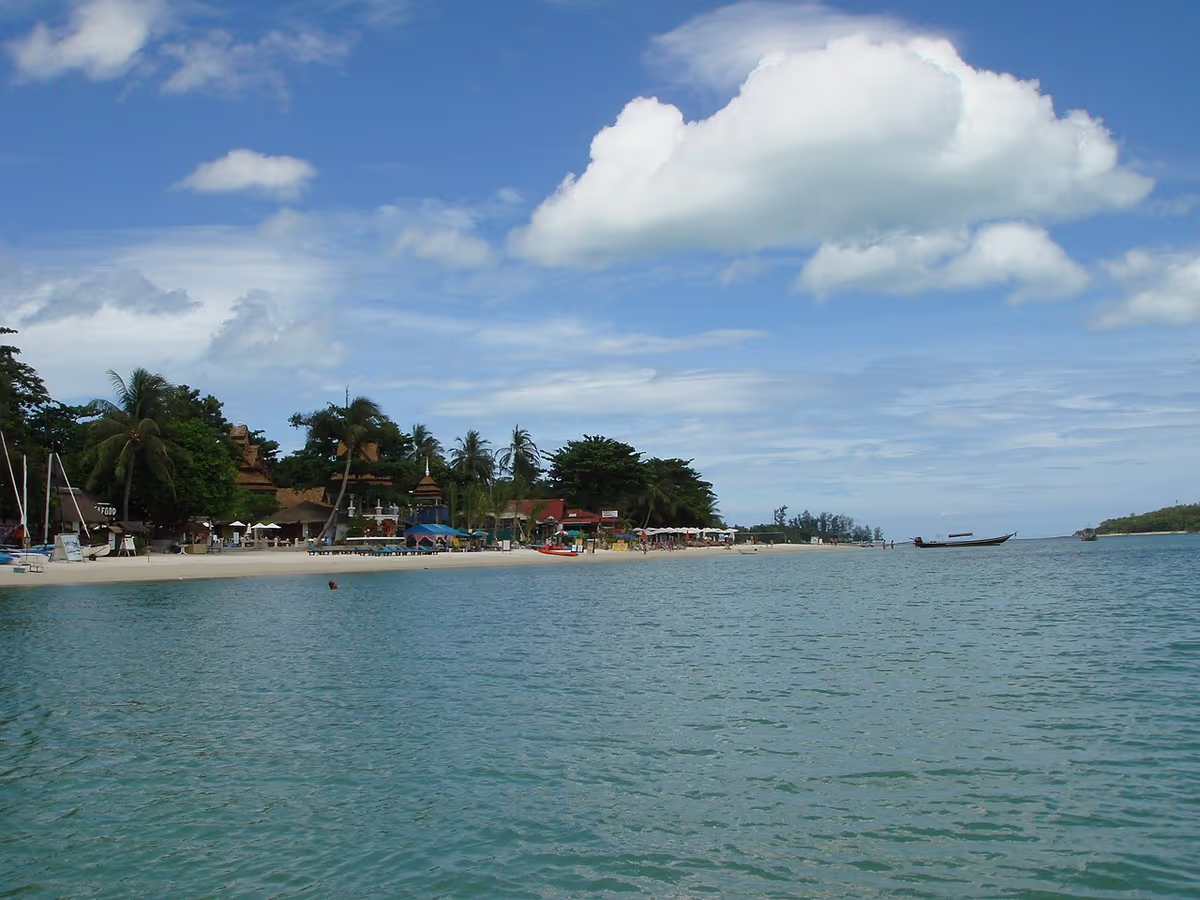
From 1 to 15 November the island is still inside the northeast monsoon. The chance of rain on any given day is around 60-75%, the sea is rough, and some boats and inter-island transfers are cancelled. These are the worst two weeks of the month.
After 15 November the monsoon retreats quickly. Rain probability drops to roughly 25-35%, and by month-end you get 6-8 hours of sunshine a day.
The practical advice is simple: if your dates are flexible and you want Samui in November, take the second half, not the first. The one exception is a tight budget. If you are chasing prices and can live with two or three days out of ten lost to indoor cafes and milky-brown water, early November is cheaper.
Local travel sources agree on the pattern: Samui's main rain window is October through November and into early December, when the northeast monsoon brings storms, disrupted ferries and flooded low-lying roads.
Which coast is drier in November and December
In November the Andaman side has not fully dried out: Phuket averages about 246 mm of rain for the month. After that the paths diverge. In December Phuket falls to roughly 140 mm, while Samui gets about 196 mm, and the above-normal rainfall on the Gulf side stretches into January.

The takeaway: from December to March, head to the Andaman coast, and save Samui and Phangan for February and March, when the Gulf dries out on its own. The exceptions are a fixed wedding date, the Full Moon Party, or a cheap February flight to Samui. By February the Gulf is already in good shape.
A caveat: all these millimetres are multi-year averages. In any specific year, November can turn out dry and January wet.
October: the month when switching coasts does not help
The popular trick of 'it is pouring in Phuket, so fly to Samui' does not work in October.
The Andaman coast is only just leaving the monsoon and dragging the tail of its September peak, while the Gulf is entering its own. The result is a narrow gap where both sides are wet. In October it makes more sense to plan cities and the north, such as Bangkok, Chiang Mai and Ayutthaya, or to spend the last ten days of the month on the Andaman coast.
What actually breaks in the rain: boats, tours and island plans
What gets disrupted is logistics, not the holiday itself. In strong wind, boats to neighbouring islands do not run, ferry timetables slip, and sea excursions are pushed to the next day, again and again.
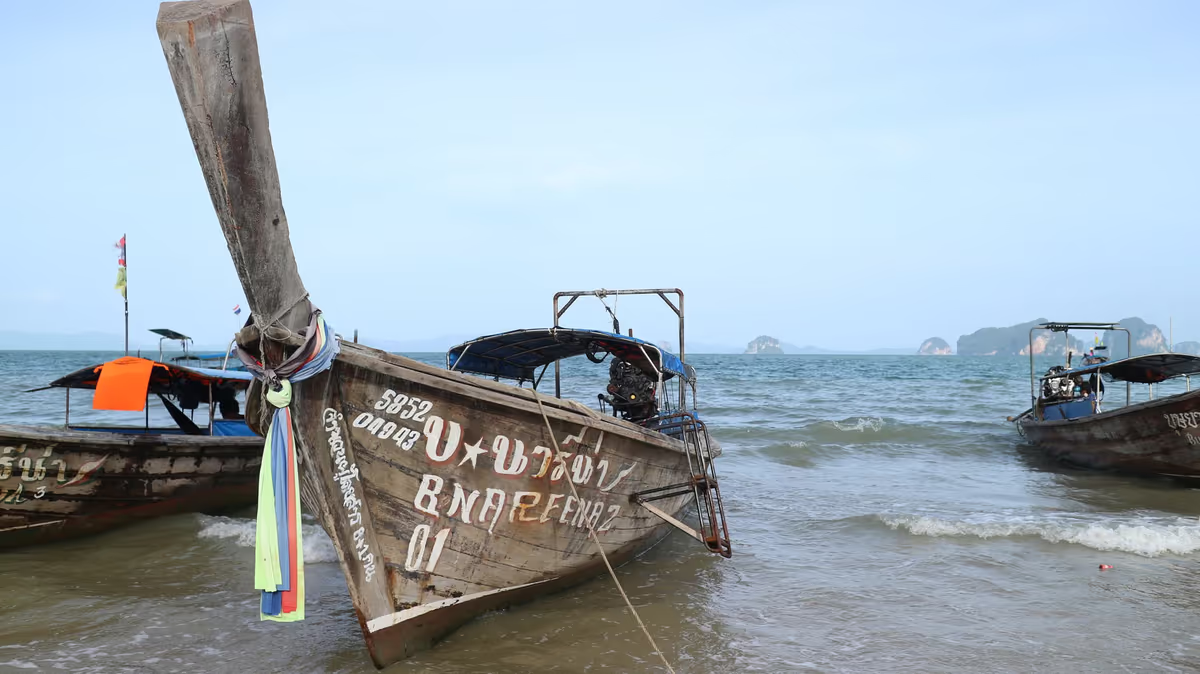
What to do about it:
- do not schedule a boat excursion on your last day before a flight; keep a spare day;
- at the peak of the monsoon on your coast, choose a flight over a boat between islands;
- book accommodation and tours with free cancellation, and if your route may still change, book a hotel that lets you shift dates;
- check the beach flags: red is not a suggestion but a ban, and many Phuket beaches fine people for ignoring it.
And a note on expectations. A rainy month is not thirty days of downpour. Even in the worst half of November on Samui, with rain probability around 60-75%, dry windows appear almost every day. The real problem of the season is usually not water from the sky but swell, murky water near the shore and cancelled boats.
FAQ
Where in Thailand is it dry in November?
There is no perfectly dry coast in November. Phuket still collects about 246 mm, while Samui is at its peak in the first half of the month. The best choice is the second half of November, and the closer you get to December, the more clearly the Andaman coast wins.
When is the best time to visit Samui and Phangan?
The dry period on the Gulf runs roughly from February to August, with February and March the driest months.
Why does it still rain on Samui in December?
The northeast monsoon lasts until mid-February. Samui gets about 196 mm of rain in December, and the above-normal rainfall extends into January.
Does it make sense to switch coasts mid-trip?
From December to March, yes: the Andaman coast is reliably drier. In October there is almost no point, because both sides are wet.
When is Phuket's wettest month?
September, the peak of the southwest monsoon. The monsoon window on the Andaman coast runs from mid-May to mid-October.
Is the weather a factor for property buyers?
Yes, it shapes rental seasons. Phuket peaks from December to March, while Samui and Phangan come into their own from February. Demand from foreign buyers for Phuket, Samui and Phangan stays strong, with an estimated 60% of Phuket villa deals involving foreign buyers or tenants, so seasonality is worth building into your rental projections.
Before booking flights for January or February, decide what matters more: calm seas or one specific island. In those months the Andaman coast delivers the calm sea, while Samui truly opens up closer to February.
Source: The CITY Asia
Ready to invest in Thailand? Our experts will help you find the perfect property.
Which area of Thailand suits you best?
We will match properties in locations that fit your goals.
What is your goal?