

Photo by Asad Photo Maldives on Pexels
Phuket Demolished 50 Structures: How to Verify a Chanote Before You Buy in 2026
This material was prepared with the help of artificial intelligence and checked by a person. Editorial responsibility: Aster Of Asia Co., Ltd..
Responsible for content: Leonid Ustinov, Aster Of Asia Co., Ltd.
Aster of Asia editorial team
On 20 July 2026, excavators moved onto Nui Beach in southern Phuket. Around 50 structures, from large commercial buildings to small canopies, were pulled down. The plot of roughly 18 rai (about 2.88 ha) turned out to sit inside the boundaries of a national forest reserve, and the land the state is taking back is valued at almost 2 billion baht.
Minister of Natural Resources and Environment Suchart Chomklin called the operation a 'model for Phuket', meaning the first in a series rather than an exception.
The key lesson for buyers: holding a title deed does not prove the land was lawfully released from the state domain. If a plot overlaps a forest reserve, a protected coastal strip or national park territory, the state can revoke the document and reclaim the land with no statute of limitations. The demolition bill does not go to whoever issued the title.
We will shortlist properties for your budget
Pick a range and we will send a shortlist with prices, layouts and payment plans within 24 hours.
Quick Answer
- Nui Beach, July 2026: about 18 rai (2.88 ha) returned to the state, around 50 structures demolished, land valued at almost 2 billion baht.
- Layan and Bang Tao, April-May 2026: more than 5 rai (about 8,000 sq m) of public coastal land recovered, roughly 16 restaurants affected; operations began with utility disconnections.
- No statute of limitations. Under Section 61 of Thailand's Land Code, an unlawfully issued title can be revoked by the Department of Lands, no matter how many times the plot has been resold.
- Leasehold does not protect you. A long-term lease derives from the underlying title: if the chanote is cancelled, the 30-year lease goes with it.
- Banks and insurers will say no. A plot with disputed zoning cannot be mortgaged, will not receive a building permit and cannot be insured.
- The problem extends beyond Phuket: improperly issued documents have also been documented on Samui and Phangan.
- What a chanote does prove: per Layan Real Estate, it is issued after a precise land survey with boundaries tied to the national coordinate grid, so boundaries can be staked out on site. It does not prove the title was lawfully created.
Main Risks and Mistakes

A chanote is the state's version of events, not a guarantee
The usual advice is to buy only a chanote (Nor Sor 4 Jor), the highest form of title. That is only half right. A chanote gives full ownership rights and exact boundary coordinates, but it does not answer whether the document was lawfully issued in the first place.
Some island titles were converted from weaker documents (Sor Kor 1, Nor Sor 3, Nor Sor 3 Gor) on land that Forestry Department maps listed as forest reserve or protected coastal zone. The conversions went through district land offices, sometimes with irregularities, sometimes with forgery. A third or fifth buyer in the chain receives a flawless-looking document with a resale history and notarial stamps.
Mitigation: demand not a copy of the chanote but the full title history from the land office, traced back to the parent document. Standard checks also include comparing the original with Land Office records and having a surveyor stake out boundaries. Add an overlay of the plot coordinates on current forest-fund and zoning maps. These are two separate checks at two separate agencies, and almost nobody does the second.
Your seller's lawyer is not due diligence
The costliest mistake on the market costs zero baht: accepting a legal check from a lawyer recommended by the developer or agent. Such reports typically confirm that the title exists, the owner's name matches and the registry shows no encumbrances. All three can be true for a plot that is demolished a year later.
Mitigation: hire an independent lawyer, paid by you, with a written mandate to check zoning, environmental status, slope and distance from the shoreline, not just registry entries.
Coastal strips and hillsides: the two most common trouble zones
Phuket has separate limits on height and density in the coastal strip, and on building on slopes or above set elevations. Sea-view villas and beach clubs right on the water fall into these zones most often, and they are exactly what inspectors are focused on now. The Prime Minister personally took an interest in the Bang Tao situation, which in Thai bureaucracy signals that inspections will not wind down.
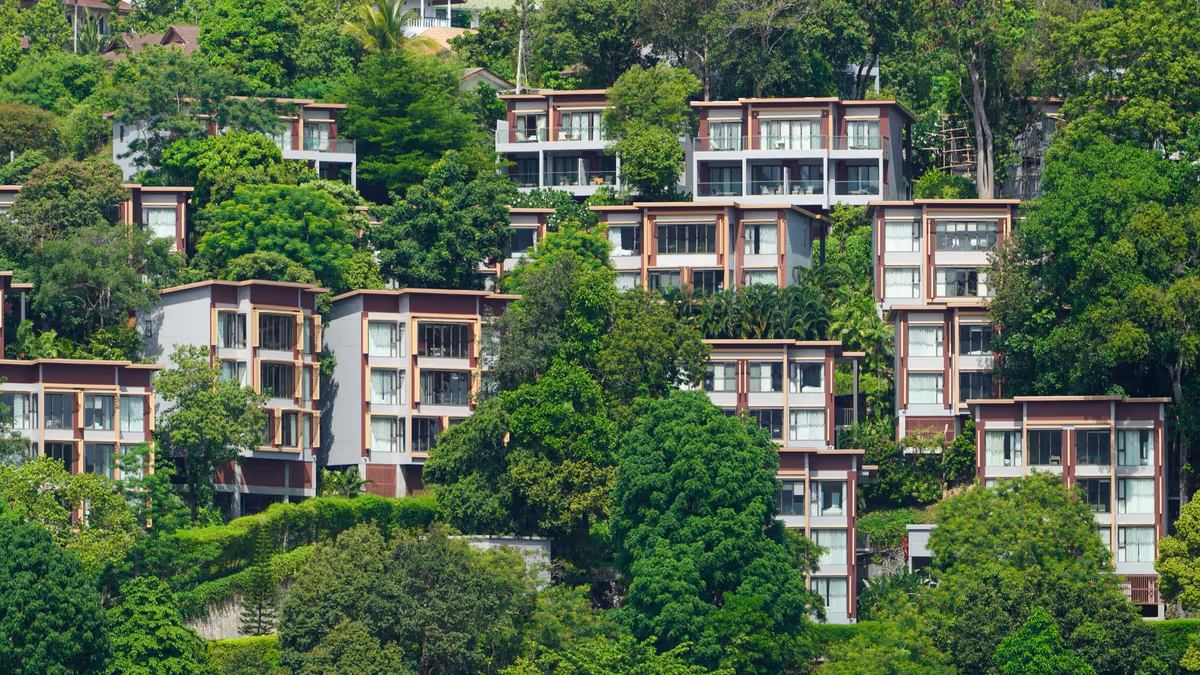
Mitigation: before paying a deposit, get written confirmation from an architect that the project is physically feasible on the plot given slope, elevation and shoreline setback. A vague answer means the build will never start.
Criminal exposure
Under Thailand's 2019 National Parks Act, occupying park land carries multi-year prison terms and heavy fines. Forest-fund land falls under a separate regime, the Forest Reserve Act. Using forged land documents is a distinct offence, and Thai courts have handed down real custodial sentences. A foreign buyer who signed without knowing of the forgery is usually not charged, but still loses the property and must pursue the seller through courts that can take years.
A dirty title kills liquidity before the bulldozers arrive
Even if demolition never comes, a plot with disputed zoning cannot be mortgaged or insured and is very hard to resell: the next buyer's competent lawyer will spot the problem within a week. The asset becomes paper you hold indefinitely.
Leasehold is not a workaround
The logic of 'foreigners cannot own land, so take a 30-year lease' solves the nationality question but says nothing about whether the base title is lawful. A lessee inherits every defect of the owner. The same applies to structures held through a Thai company: checks on company-registered land are running in parallel with equal intensity.
Condos: lower risk, not zero
A unit in a registered condominium within the 49% foreign quota stands on land already reviewed at project registration, so direct exposure is rare. But if the building sits on a slope or on the beachfront, the legality of its construction permit remains a fair question to ask.
FAQ
Can I check a plot myself using the chanote number?
Partly. The provincial land office issues an extract with ownership history and encumbrances based on the title number and survey sheet number. Overlaying the plot on forest-fund maps is a separate task that needs a specialist who can read Thai agency maps.
How much does proper legal due diligence cost?
Market estimates put independent due diligence, including a site visit and inquiries to several agencies, at noticeably less than one percent of a typical Phuket villa price. It is the one line in the deal where cutting costs makes no sense.
If a title is revoked, do I get my money back?
The state does not compensate. You must claim against the seller under the sale contract, so everything depends on the title warranties in that contract and on what remains of the seller as a legal entity.
Does this affect condominium apartments?
Rarely and indirectly. A unit in a registered condominium with foreign quota stands on land already vetted at registration. For slope or beachfront buildings, ask about the construction permit.
Is only Phuket under scrutiny?
No. Improperly issued titles are documented on Samui and Phangan too. How quickly the same inspection intensity reaches them is hard to predict: administrative capacity is limited and political attention is currently focused on one island.
Does being a good-faith purchaser protect me?
In Thai practice on forest-fund and national park land, a buyer's good faith does not create rights the state never had when it issued the document. Public interest takes priority.
What should an owner already in an inspection zone do?
Do not demolish anything voluntarily and do not ignore notices. Owners of structures at Nui are challenging the authorities in administrative court without physical resistance, which is the only workable approach. At the same time, rebuild the full document chain: sometimes the error lies with the agency, and that can be proven.
Could the market crash because of these inspections?
More likely the opposite. Clearing disputed titles makes the market more transparent, and properties with clean documents gain value relative to the rest. Holders of questionable assets suffer, not the market as a whole.
What should I do right now?
If a plot or villa is within a few hundred metres of the shoreline or on a hillside on Phuket, Samui or Phangan, do not pay a deposit until an independent lawyer has traced the title to its parent document and overlaid the boundaries on forest-fund maps. If the seller rushes you, promises to do checks 'after the deposit' or offers their own lawyer, walk away. There are thousands of such properties on the island, but a revoked chanote only needs to happen once. Visit the plot yourself before transferring money and check neighbouring buildings, signs of recent notices and the access road, which can also turn out to be state land.
Source: Layan Real Estate
Ready to invest in Thailand? Our experts will help you find the perfect property.
Which area of Thailand suits you best?
We will match properties in locations that fit your goals.
What is your goal?