

Photo by Dale Mohagan on Pexels
Bangkok's 100 Billion Baht Flood Plan: Who Wins and Who Doesn't
This material was prepared with the help of artificial intelligence and checked by a person. Editorial responsibility: Aster Of Asia Co., Ltd..
Responsible for content: Leonid Ustinov, Aster Of Asia Co., Ltd.
Aster of Asia editorial team
Do the math. Bangkok's city administration has pledged at least 100 billion THB for flood protection over 5-7 years, or roughly 14-20 billion THB a year. The World Bank put the damage from the 2011 floods alone at 1.44 trillion THB nationwide. One year of the program covers about one percent of that catastrophe.
That does not make the money useless. It does mean you should not expect it to reprice the whole market.
The short answer for investors: the program adds almost nothing to prices in Sukhumvit and Sathorn, where water does not stand for weeks anyway. It could genuinely change the picture in the north and east of the city, in Don Mueang, Sai Mai, Bang Khen, Lat Phrao and Min Buri. But any price premium there will appear in the month a specific pumping station or drainage tunnel opens, not on the day the budget is announced.
We will shortlist properties for your budget
Pick a range and we will send a shortlist with prices, layouts and payment plans within 24 hours.
Quick Answer
- Size of the program: at least 100 billion THB over 5-7 years, about 14-20 billion THB per year, against a city budget of roughly 90-100 billion THB a year.
- Main works: more underground drainage tunnels, pumping stations, closing gaps in the flood wall along the Chao Phraya River, and deepening canals.
- Biggest winners: the low-lying north and east, namely Don Mueang, Sai Mai, Bang Khen, Lat Phrao, Min Buri, Nong Chok, plus coastal Bang Khun Thian.
- Central business district condos: price impact is close to zero, because the premium there comes from transport and land scarcity, not water.
- Biggest risk: the 350 billion THB water management program announced after 2011 was never delivered as designed.
- Realistic repricing window: 3 to 7 years after a specific project starts operating, not after a press conference.
For context on how selective Bangkok's market already is, the Bangkok Post reports developers are slowing new condo launches to clear inventory as unsold stock declines, which suggests prices in established locations are driven by supply discipline rather than infrastructure announcements.
Key Facts
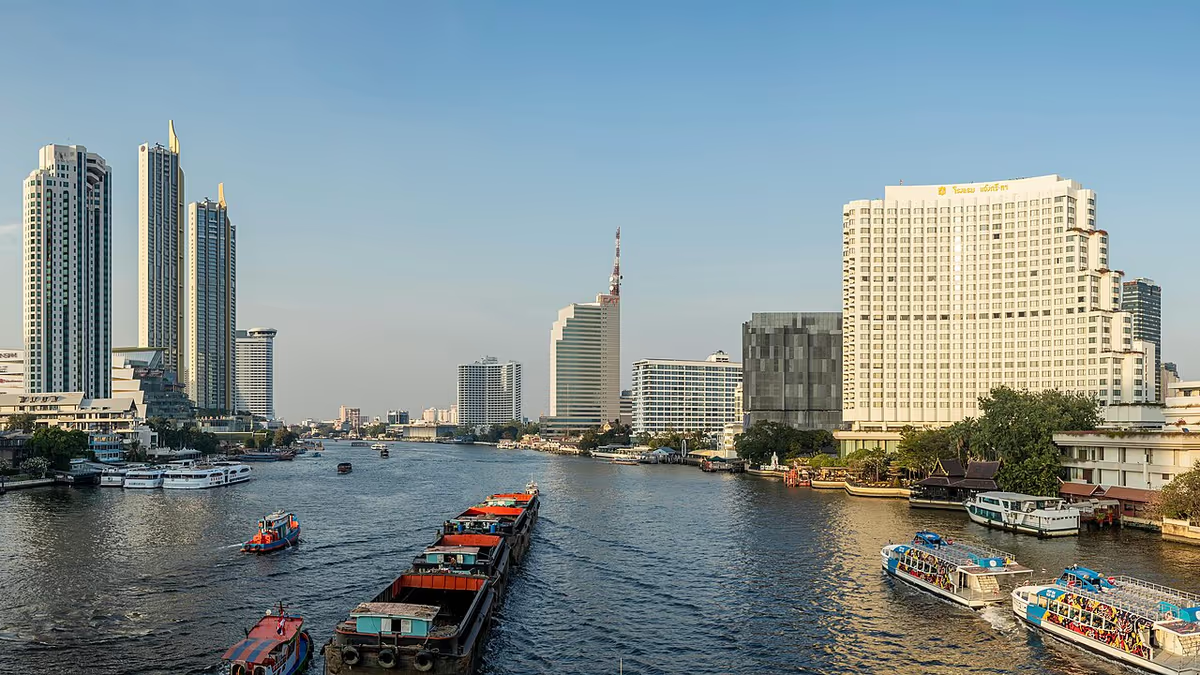
- The 2011 floods affected more than 60 provinces in Thailand, with total damage estimated by the World Bank at about 1.44 trillion THB. Industrial estates in Ayutthaya and Pathum Thani stood under water for up to two months.
- Bangkok is sinking by roughly 1-2 cm per year, and a large part of the built-up area lies only 0.5-1.5 m above sea level.
- The largest operating underground drainage tunnel in the city is the Bang Sue tunnel, about 6.4 km long with a capacity of around 60 m3/s. New tunnels follow the same logic: water travels underground to the river, bypassing clogged canals.
- About 87 km of flood walls have been built along the Chao Phraya within city limits, but gaps on private land have persisted for decades. Those gaps are how water entered neighborhoods such as Yang Nawa and Bang Kho Laem.
- After 2011, Thai insurers introduced sub-limits for flood risk. Water coverage in a typical home policy is capped well below the insured value of the property, and full cover is a separate, pricier option.
- Price dispersion across the city remains huge: new-build condos in central locations run 200,000 to 350,000 THB per sqm, while peripheral districts along metro lines run 70,000-110,000 THB per sqm.
Which districts actually benefit
The logic is simple: value gains accrue where risk was high and is now being removed. In Sathorn and along Witthayu the risk is already low, so there is nothing to remove.

The north is different. Don Mueang went under water in 2011 together with its airport, and that memory still shapes how Thai buyers view any house there. Sai Mai, Bang Khen, Khlong Sam Wa, Min Buri and Nong Chok have historically served as a buffer, holding northern water back to protect the center. If the new tunnels and pumps really remove that scenario, land and townhouses there will reprice the most.
Bang Khun Thian is a special case, the only Bangkok district with a sea frontage. Its problem is not rainfall but coastal erosion and rising seas. Money for mangrove belts and breakwaters there is less a price premium than a condition for prices holding at all.
The Thonglor-Ekkamai corridor, popular with expats, does not fit this map. It has no week-long flooding, but it does get regular flash floods after heavy downpours: sois turn into canals for an hour, water reaches ankle height, and underground parking takes the first hit. That is a local drainage and backwater problem, not something a 100 billion THB dike program solves. An apartment on the 15th floor loses nothing. A car on level B1 does.
Why I would not buy on a promise
The precedent is too recent. In 2012 the government announced a 350 billion THB water management program with nine modules, dams, bypass channels and diversion of water around Bangkok. Contracts were challenged in court, and after the 2014 change of government the project was effectively dismantled. Only a fraction was built, and people still argue about how much.
So I read the 100 billion THB over 5-7 years figure as a framework of intent, not a delivery schedule. The city's own budget is about 90-100 billion THB a year, and committing 15-20% of it to water while still paying for waste collection, buses and schools is hard. Part of the money will almost certainly come through loans and the central budget, which ties it to the political cycle.
Practical takeaway: do not pay 10-15% above market because a tunnel is coming. Buy when the tunnel is running and has survived at least one rainy season.
What it means for a condo buyer
Water affects condo prices in three ways, and none of them concerns the unit's floor level.
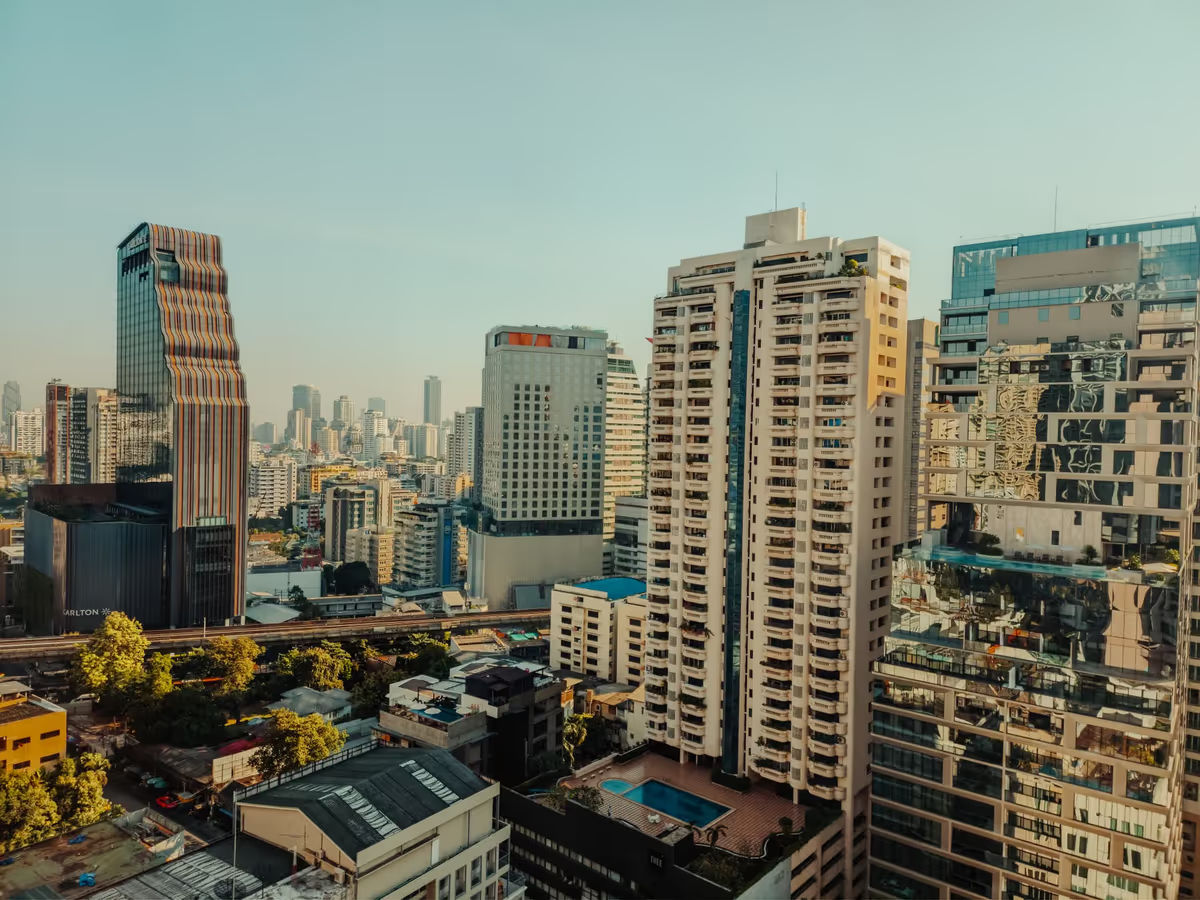
- Parking and commercial podium. A flooded basement means repairs from the building's common fund, a higher sinking fund and weaker retail tenant interest on the ground floor.
- Resale liquidity. Thai buyers remember 2011 better than foreigners do. A property in a district with a reputation for flooding sells slower and at a bigger discount, even if that particular building was never hit.
- Insurance and running costs. Full flood cover for a building in a risk zone costs more, and that feeds into the monthly common area fee paid by the owner, not the tenant.
If you plan a viewing trip, come in September or October, at the peak of the rainy season. In three days you will learn more about a district's drainage than from any report.
The one condition under which all of this can be ignored: you are buying in a high-rise on a BTS line with a budget up to 5 million THB for rental. There, flood risk is secondary to walking distance to the station, the volume of new supply within one kilometer and the quality of the management company.
FAQ
Will my apartment in Bangkok flood?
A unit above the second floor is practically outside the risk. The threat concerns underground parking, lift shafts, electrical rooms and the entrance lobby. In 2011 many buildings lost not the apartments but access: water stood in the street, lifts were switched off, and residents left for a month.
Which Bangkok districts flood most often?
Historically the north and east: Don Mueang, Sai Mai, Bang Khen, Lat Phrao, Khlong Sam Wa, Min Buri and Nong Chok. Add coastal Bang Khun Thian and some stretches along the Chao Phraya where gaps remain in the protective wall.
Will prices rise after new dikes and tunnels are built?
In high-risk zones, yes, but with a lag. The market reacts to a completed facility, not an announcement. Plan on a 3-7 year horizon and favor land assets, since houses and townhouses reprice more than condos.
Should I buy in the center to avoid the water problem?
The center is drier, but you do not pay a separate premium for that, because it is already in the price. In the CBD you are buying transport access and scarce land, and flood protection comes as a bonus.
Can I insure an apartment against flooding?
Yes, but read the sub-limits carefully. After 2011 Thai insurers capped water coverage in standard policies. Extended cover is a separate option and costs more than the base tariff.
How do I check a specific address before buying?
Three steps: check satellite imagery and the plot level relative to the neighboring road, ask security staff at nearby buildings what happened in the last heavy downpour, and view the property during the rainy season. The seller will not tell you about water.
Does ground subsidence affect long-term value?
Indirectly, through flooding risk. Sinking at 1-2 cm per year means the street level relative to water slowly worsens, and districts that are dry today may need pumps in 15-20 years. That is an argument for new projects with a raised ground floor.
Does the program cover resort areas like Phuket and Pattaya?
No. The 100 billion THB is the Bangkok city administration's budget. Phuket has its own storm drainage problems in Patong and Chalong, funded separately and far more modestly. For investors weighing both markets, foreign buyers made up over 40% of Phuket condo purchases in 2025 versus 26% in Bangkok, according to Layan Real Estate.
Recommendation: before buying in any district outside central Bangkok, ask the developer for the ground-floor level relative to the road and the plot's flooding history over the past 15 years. If they have no numbers, treat the area as risky and negotiate 5-10% off instead of overpaying for a future tunnel.
Source: Bangkok Post
Ready to invest in Thailand? Our experts will help you find the perfect property.
Ready to start?
Answer 4 questions and we will prepare a personalised selection of property in Thailand.
What is your goal?