

Photo by Joerg Mangelsen on Pexels
Is Thailand Safe in 2026? Rip Currents, Jellyfish, Scooters and Scams
This material was prepared with the help of artificial intelligence and checked by a person. Editorial responsibility: Aster Of Asia Co., Ltd..
Responsible for content: Leonid Ustinov, Aster Of Asia Co., Ltd.
Aster of Asia editorial team
A red flag on the beach is not a suggestion. It is the only thing standing between you and a rip current. Thailand is generally safe: serious violence against tourists is rare. The real dangers are different: scooters, the sea on the Andaman coast from May to October, and scammers who follow a pre-written script.
What Actually Makes the Sea Dangerous
The main cause of tourist deaths in the water is not sharks or rocks but rip currents. These are narrow channels that pull water from the shore back out to sea. They move at 4-8 km/h, faster than an average swimmer. They are 10-30 metres wide and can extend 100 metres or more from the beach.
They look like an invitation. Where waves are not breaking and the water seems calm, swimmers instinctively gather. That smooth corridor between breaking waves is the current. Other signs include murky water, foam and debris drifting out to sea, and ripples in the middle of an otherwise flat surface.
We will shortlist properties for your budget
Pick a range and we will send a shortlist with prices, layouts and payment plans within 24 hours.
The current does not drown you. Panic and trying to swim against it do.
If you are caught, do not swim toward the shore. Swim parallel to the beach until you leave the flow, then turn in. If you run out of strength, float on your back and wave an arm.
Strong currents are regularly recorded at Cha-Am and Hua Hin, on Samui, in Pattaya, on Phuket and in Rayong, which are exactly the places with the most holidaymakers. On the Andaman side the risk peaks from May to October because of monsoon swell and warning flags. Independent Phuket safety guides give the same advice: a red flag with a no-swimming sign means stay out of the water entirely, and never swim at night or after drinking.
One more uncomfortable point: local lifeguard services and dive schools do not always operate to international standards. Do not count on someone swimming out to get you. Choose beaches with lifeguards actually seated in a tower, and with a red flag up, do not go in at all, not even waist-deep.
Rent water sports equipment only from operators tied to major international organisations. If a dive centre has no clear certification, the question is not price but where you would find a hyperbaric chamber afterwards: they exist in Bangkok and in the south, but not on every island.
Jellyfish: Where They Are and What to Do After a Sting
Fatal jellyfish cases have been recorded near Koh Lanta, Koh Phangan, Phi Phi, in Krabi and on Phuket. That is no reason to skip swimming, but it is a reason to read the signs at the beach entrance: when jellyfish wash ashore, warnings are posted.
Besides jellyfish, the water holds corals and anemones. A coral cut heals slowly in the tropics and infects easily, so reef shoes are not just for show.
If you are stung, follow the instructions on the beach sign and do not delay seeing a doctor. A severe reaction needs help immediately, not after you reach the hotel and start googling. Do not assume burning pain will simply pass.
Roads and Scooters: The Most Underestimated Risk
If you make an honest list of what hurts tourists in Thailand most often, the scooter sits at the top. Not the sea, not crime, not food: the road.
The position here is simple: if you have not ridden a motorcycle at home, do not start in Thailand. Left-hand traffic, wet asphalt in the rainy season, sand on corners and dense traffic make poor conditions for a first ride. There is one exception: you live on a quiet island and ride two kilometres to the shop on an empty road in daylight. Then the argument loses force.
The minimum if you do get on:
- a licence with an open category A plus an international permit;
- a helmet at all times, including for the passenger;
- no riding at night;
- not a single drink;
- photograph the bike from every side before leaving the rental lot.
Without a motorcycle category, insurance after a crash typically pays nothing, neither medical costs nor damage to other vehicles. That bill is what turns a holiday into a disaster.
The alternative is cheaper than it looks: Grab, Bolt and ordinary metered taxis. On arrival it also helps to book an airport transfer in advance so you are not haggling at the terminal exit after a long flight.
Scams That Still Work in Thailand
Almost all local scams involve no violence. They rely on surprise and polite pressure, and each has a recognisable script.
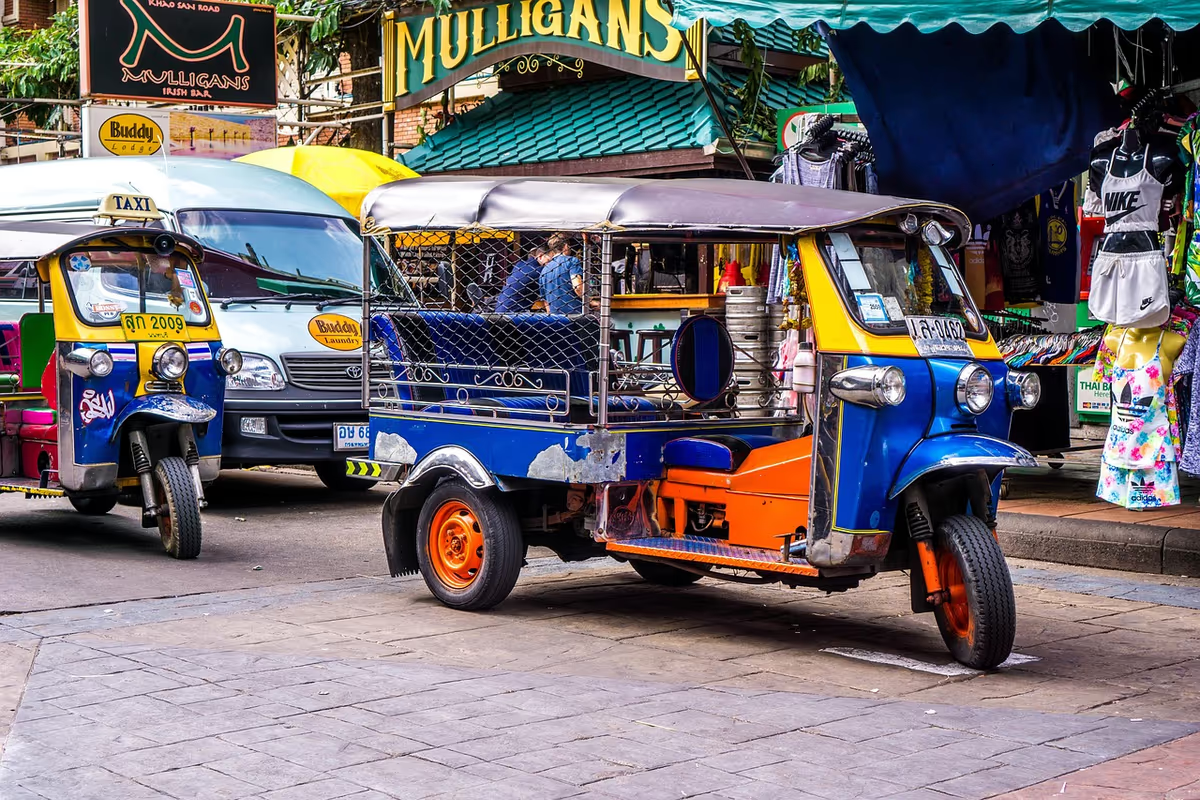
The Bangkok gem scam. It has run for decades. A driver or friendly stranger says the temple is closed, but today is a special day and gems are sold tax-free. Then comes the shop, the tea, the pressure. The stones turn out to be glass or cost many times what they should. Any offer of a free or suspiciously cheap city tour ends in such a shop. Decline and take another vehicle.
The scooter scratch. The bike is returned and a damage you did not cause is found, with an aggressive repair estimate on the spot. Hence the rule of photos and video before you leave, including plastics, exhaust and wheels.
Taxis without a meter. In Bangkok the meter is mandatory, and a driver who offers a fixed price almost always wants more. Insist on the meter or book through an app.
Extra charges on websites. Forms that show a wrong bill or demand fees that do not exist. Handle visa and immigration matters only on official resources.
All of these share one trait: you are rushed and given no time to think. A thirty-second pause and a calm no break the script. Enforcement is catching up too: Phuket Tourist Police are building an information-sharing network with 15 foreign nations, including Germany, France, Switzerland and Spain, to track foreign offenders and illegal traffic violations.
Dogs, Monkeys and Other Wildlife Near Your Accommodation
Stray dogs are everywhere in Thailand and usually leave people alone by day. Trouble starts in the evening and in groups: a pack by the road, a runner or cyclist passes, and they give chase. Do not run or shout. Walk calmly and evenly, keeping a bike or bag between you and the dog.
Monkeys are a separate matter. Where they are fed, they have no fear of people and know exactly that a plastic bag means food. Put bags and phones away, never feed them, and certainly do not approach for a selfie.
Any bite or scratch from an animal means a clinic visit the same day, not watching the wound. Rinse it with soap and water and go.
FAQ
Is Thailand safe for solo travellers or families with children?
Yes. The country is considered safe for solo women, families and older travellers, and serious attacks on foreigners are rare. The main risks are everyday ones: roads, water and overcharging.
Can I swim under a red flag if the sea looks calm?
No. A calm-looking strip between breaking waves is often the rip current itself, 10-30 metres wide. A red flag means do not enter the water at all.
Which months are most dangerous for swimming in Phuket?
May to October, during the monsoon on the Andaman coast. Swell and currents are stronger, and some beaches are flagged off for several days at a time.
What should I do if a jellyfish stings me?
Get out of the water, follow the instructions on the beach sign, and seek medical help straight away if the pain is severe or your condition worsens. Fatal cases have been recorded near Koh Lanta, Koh Phangan, Phi Phi, in Krabi and on Phuket.
How do I avoid the Bangkok gem scam?
Ignore any offer of a free or very cheap city tour and any claim that the temple is closed today. That is the opening of the gem-shop scam, which has run for many years.
Is it safe to rent a scooter in Thailand?
Only if you already ride at home, hold a licence with an open category A plus an international permit, wear a helmet and never ride at night or after drinking. Without the right licence category, insurance typically pays nothing after a crash.
What is the safest way to get around instead?
Grab, Bolt and metered taxis. In Bangkok the meter is mandatory, so insist on it or book through an app.
What is the best first-day safety step?
Save the number of the nearest hospital with an emergency room and check on the map how far it is from your accommodation. On islands it can be forty minutes along a winding road, and it is better to learn that in advance than with a coral cut.
Source: Pattaya Mail
Ready to invest in Thailand? Our experts will help you find the perfect property.
How much could your investment earn?
We will match rental properties and show you the real yield.
What is your goal?