
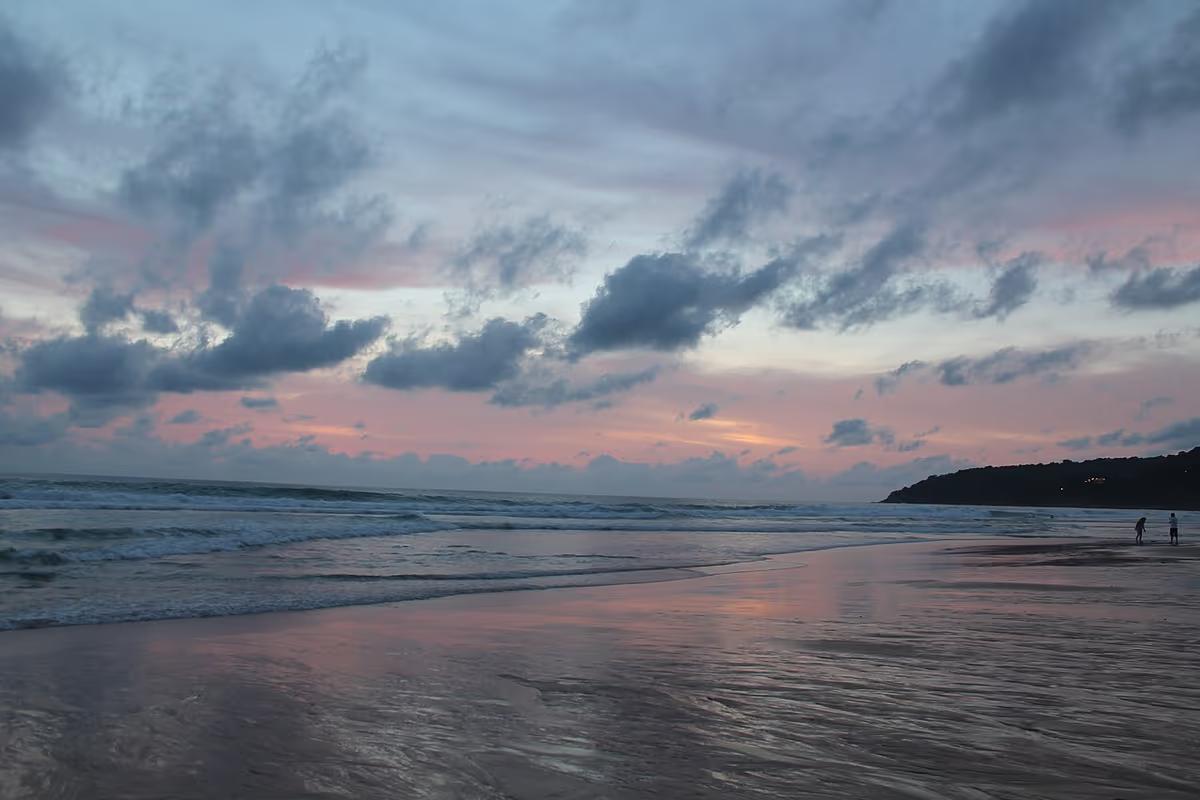
Photo: Pather alexiy, CC BY-SA 3.0, Wikimedia Commons
Karon Beach, Phuket: Swimming Season, Flags and Rip Currents
This material was prepared with the help of artificial intelligence and checked by a person. Editorial responsibility: Aster Of Asia Co., Ltd..
Responsible for content: Leonid Ustinov, Aster Of Asia Co., Ltd.
Aster of Asia editorial team
Karon is best for swimming from November to April, when the sea is calm and visibility near shore is usually 5-10 metres, reaching 15-20 metres on the best days. From May to October the southwest monsoon pushes waves up to 2-3 metres, and the red flag can stay up for weeks along the length of the sand.
The beach is an arc of roughly 1.4 km open to the west, backed by dunes, casuarina trees and palms. Because the bay faces west, everything the monsoon brings arrives with nothing to block it. Other local sources measure the full stretch at 3+ km, which makes Karon one of the longest beaches on Phuket's southwest coast.
Sea conditions by month
We will shortlist properties for your budget
Pick a range and we will send a shortlist with prices, layouts and payment plans within 24 hours.
- November to April: flat sea or light ripple, visibility 5-10 m near shore (15-20 m on good days). Swimming is fine within the lifeguard zone.
- May to June: swell builds and the water clouds. Swim only if the flag allows.
- July to August: waves of 1-2 m with hard shore break right at the waterline. Swimming is more often banned than not.
- September to October: heavy swell, peaking at 2-3 m. Usually banned.
The calmest water runs from December to April. If you are coming for the sea or snorkelling, plan around those months rather than just 'winter'. May and October are transitional: you can get a week of perfect calm followed by three days when nobody is allowed in the water.
The beach itself is also worth knowing for its fine white quartz sand, which squeaks underfoot (the so-called singing sand) and does not get scorching hot, though it gets into everything you bring.
The flag system and why people ignore it
The system is simple:
- Red: no swimming, dangerous waves or currents.
- Yellow: caution.
- Green: swimming allowed, within the lifeguard zone.
- Paired red-yellow flags: the zone where a lifeguard can actually see the water.
Karon's problem is not a shortage of flags. From the sand, the monsoon sea looks deceptively calm: a long, gently sloping bay where the surf seems low. People wade in to the knee and assume all is well. Then shore break takes over: the wave collapses right at the edge and slams downward rather than forward. That is how people end up with dislocated shoulders and neck injuries without ever swimming.
There is a second point that gets mentioned less often. During the monsoon there are fewer lifeguards on the beach, even though the water is most dangerous then. A red flag with no lifeguard nearby does not mean 'nobody is here, so it must be fine'. It means nobody is there to pull you out.
Where the dangerous currents are
The bay is long, and rip currents in the monsoon form in bands rather than at a single point. Two areas are consistently worse than the rest:
- The north end, by the rocky headland toward Patong, where rip currents are reported most often.
- The south edge, near the border with Kata, where strong return flows pull swimmers away from shore.
The middle of the beach, where the lifeguards sit, is better. There is a sandbar near shore, and the water inside it is shallow and calm, which is why the centre is recommended for families with children in high season.
Here is the common mistake. Beyond the sandbar the bottom drops away, and water that has washed over the crest returns to sea through one or two channels. In January the area inside the bar is a true paddling pool. In August the same bar becomes a current generator: you wade in to the waist, get nudged along the shore, then pulled away from it.
The rule holds year-round: swim only between the red-yellow flags. If in doubt, stay out.
What to do on Karon from May to October
Bluntly: if you are visiting Phuket in July with a child and the sea is your priority, Karon is not the best choice for swimming. Book accommodation with a pool and treat the beach as a place to walk. In low season, hotels offer discounts of 40-60%, so the pool costs less than you might expect.
The beach does not disappear in the monsoon, and in places it is more interesting: a long line of breaking surf, empty sand on a weekday, sunsets without the crowds, and cafes along the road still open. Some people come specifically to watch the storms.
The one exception is surfing. For boards the monsoon is the season, so there is no point steering surfers toward winter calm.
When to book accommodation in high season
High-season prices run roughly 20-40% above low season, and in December and January hotels on Karon are close to full. A sensible window is booking about 60 days ahead; for New Year dates, looking in November is already too late.
If you plan to winter here and want to see the area first, it is easier to book a hotel for a couple of weeks in the central part of the beach, near the lifeguard zone, and view long-term rentals from there. The north of Karon is quieter and further from restaurants; the south is closer to Kata and the nightlife.
A common story: someone picks an apartment from a sea-view photo, then discovers the walk down to the sand is along a road with no pavement. Development on Karon stretches along the coastal road, and a 'second line' building can sit closer to the water than a hillside property with a view.
One useful point for buyers: western-coast beaches like Karon give you a beach routine for roughly six months of the year, so seasonality matters as much as sand and views when choosing where to live.
FAQ
Which month has the calmest sea on Karon?
December to April. Waves are minimal, the water is clear, and visibility near shore is most often 5-10 metres or better.
Can you swim on Karon in July and August?
Often not. This is peak monsoon: waves of 1-2 metres, hard shore break at the waterline, and red flags raised regularly. Go only by the flag on the tower on the day you swim.
Where is Karon safest for children?
In the central section, between the red-yellow flags, where there is a shallow sandbar near shore and a lifeguard on duty. That applies to high season. In the monsoon the sandbar itself becomes a source of current.
What should I do if a current carries me out?
Do not swim against it toward shore. Swim parallel to the beach, across the current, until it releases you, then angle back to the sand. Raising an arm signals the lifeguard.
How does Karon differ from neighbouring beaches in wave exposure?
Karon is longer and fully open to the west, so in the monsoon it has several rip-current zones and noticeably harder shore break than smaller, sheltered bays.
When should I book a stay on Karon for winter?
About 60 days ahead. December and January fill almost completely, and New Year dates need to be secured well before November.
Source: Everprime Condo (Karon vs Patong Beach guide)
Ready to invest in Thailand? Our experts will help you find the perfect property.
Which area of Thailand suits you best?
We will match properties in locations that fit your goals.
What is your goal?