
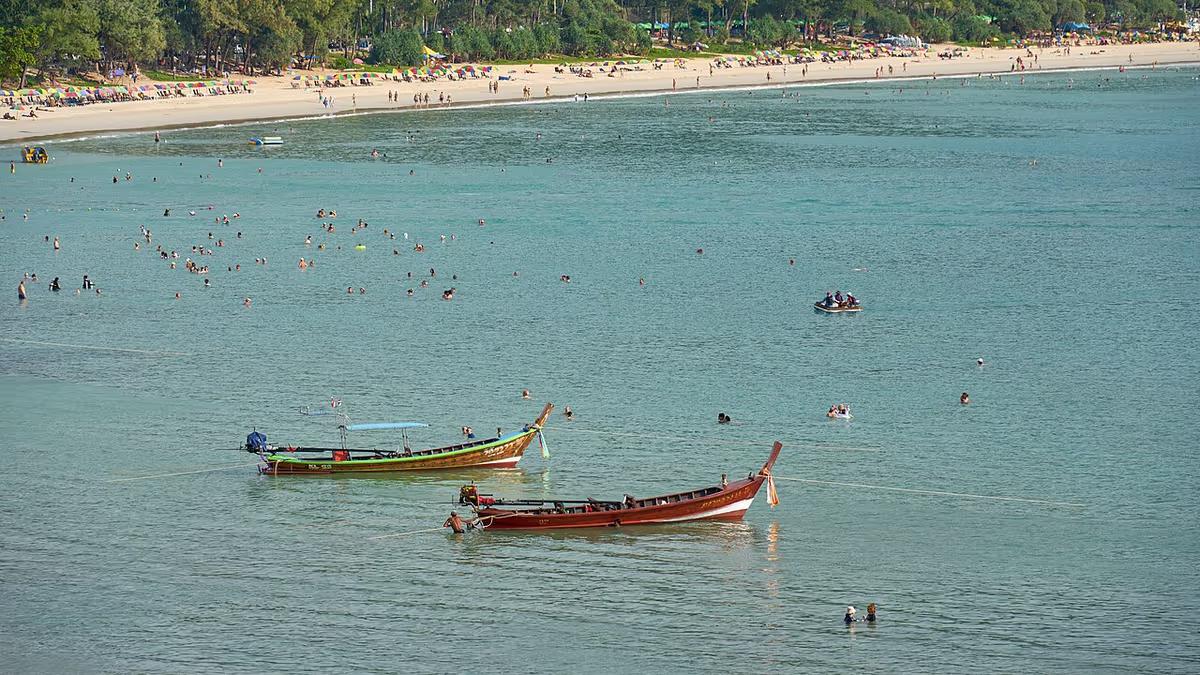
Photo: Radek Kucharski, CC BY 2.0, Wikimedia Commons
Kata and Kata Noi: Summer Surf and Calm Winter Seas in 2026
This material was prepared with the help of artificial intelligence and checked by a person. Editorial responsibility: Aster Of Asia Co., Ltd..
Responsible for content: Leonid Ustinov, Aster Of Asia Co., Ltd.
Aster of Asia editorial team
In January you can wade into Kata up to your waist and find little more than a ripple: the bay sits almost glassy. In July the same spot gets waves of 1-2 metres, with sets reaching three. Surf season here runs May-October, and calm swimming runs November-April. A foam board with a leash costs 150-200 baht per hour.
When Kata has surf and when it is flat
Kata (also called Kata Yai) is the most consistent surf beach on Phuket. Swell arrives from the southwest with the monsoon, from May to October. During this period a reef break works at the northern end of the bay, and conditions there are tougher than at most beaches on the island.
We will shortlist properties for your budget
Pick a range and we will send a shortlist with prices, layouts and payment plans within 24 hours.
Beginners are best served by roughly 0.5-1.5 metres, and such days are common in season. But the same swell on a bad day produces 3-metre sets, and then only experienced surfers belong in the water.
From November to April everything changes. The sea smooths out, the water turns clear, and near the rocky southern headland you can snorkel in comfort. Surfing is almost impossible in these months: boards sit in rental shops and schools close until May.
March and April are a transition. It is hot, the water is warm and the swell is only starting to build. Swimming is comfortable, but the dead calm of November-February is gone.
The west coast of Phuket (Patong, Kamala, Karon, Kata, Surin, Bang Tao) takes the southwest monsoon from May to October, which brings waves and rip-current risk. The east coast (Chalong, Ko Keo, Panwa) stays smooth year-round, though the water and sand are poorer for swimming.
How Kata Noi differs from Kata, and where it is riskier
Kata Noi is the neighbouring bay just to the south: smaller, quieter, with pricier hotels along the shore. It is a crescent of sand with a gentle sandy entry, and in the dry season the water stays calm thanks to the shape of the bay.
Here the most common assumption breaks down. People reason that a small, sheltered bay keeps the waves out, so swimming must be safer. In the dry season that is true. In the monsoon, rip currents at Kata Noi can be stronger than at the main Kata beach, and there are no permanent lifeguards.
In July you are alone with the water: nobody with a whistle is nearby, and nobody will raise a red flag for you.
The practical conclusion: from May to October, swim at Kata Yai, where lifeguards mark a safe zone with flags. Kata Noi in those months is for quiet, views and breakfast, not for swimming. If you swim confidently in the ocean, recognise a rip from shore and know to swim parallel to the beach rather than against the current, this advice is not for you.
What a board costs and where beginners learn
Surf schools operate at the northern end of Kata and are open May to October. A softboard rental with a leash costs 150-200 baht per hour. This is the beginner standard: the board is soft and forgiving when you fall.
Worth keeping in mind:
- One hour of rental is just enough to find out whether you enjoy lying on a board and paddling
- The first lesson almost always happens in whitewater near the shore, not on a clean wave
- Conditions for learning are usually best early in the morning, before wind roughens the surface
- Lesson prices depend on the school and the time within the season, so ask directly on the beach
A leash is mandatory. Without one, even in half-metre surf the board shoots to shore on its own and hits people standing in the water.
What the red flag at Kata really means
Lifeguards at Kata use flags: green means swimming in the marked zone is allowed, red means it is not. Not 'be careful' and not 'at your own risk', but simply no swimming.
During the monsoon red flags go up regularly, sometimes mid-day: shorebreak and rips at Kata develop fast, within half an hour. Sometimes lifeguards close the water entirely.
A typical mistake is seeing surfers in the water and deciding that if they are out there, it must be fine. But a surfer lies on a floating board strapped to the ankle and knows where the current runs. A swimmer has none of that.
A second mistake is snorkelling at the southern headland of Kata in the low season. In calm weather it is a good spot with rocks and fish, but in the monsoon the current pulls you in and the rocks stop being scenery.
Which month to choose for your goal
From November to February expect calm, clear water and a gentle entry, ideal for families with children, swimming and snorkelling. March-April is hot with building waves, good for swimming plus first attempts on a board. May-October brings waves of 1-2 m, sets up to 3 m and frequent red flags, suited to surfers from beginner to intermediate level.
If you travel with children under ten, choose December, January or February, no question. If your goal is to learn to stand on a board rather than fight for a spot in the line-up, look at the edges of the season: late May and September are usually less crowded than peak summer.
A note for property buyers
Kata consists of two bays, Kata Yai and Kata Noi. Much of the land is gently sloping, with few flat plots for large projects, so new buildings tend to rise on hillsides (Kata Hill, the road to Kata Noi). A sea view on a slope costs noticeably more than similar space deeper in the valley. Foreign buyers can hold a condominium freehold within the 49% foreign quota, while villas are usually acquired on leases of up to 30 years. Demand is seasonal: the beach-and-surf character of Kata means summer activity is lower than in the dry months.
Source: Flo Defort
Ready to invest in Thailand? Our experts will help you find the perfect property.
FAQ
Can you swim at Kata in July?
At the main Kata beach, only in the zone marked by lifeguards and only under a green flag. At Kata Noi in July there are no lifeguards, and the rip current can be stronger. Waves in these months are usually 1-2 metres.
When is the sea calmest at Kata?
From November to February. The water is clear, the entry is gentle and sandy, and there are almost no waves. This is the best window for families with small children.
How much does a surfboard rental cost?
A foam board with a leash costs about 150-200 baht per hour from schools at the northern end of Kata. The schools operate from May to October.
Which is better for surfing, Kata or Kata Noi?
Kata Yai: it has a reef break in the north, schools and rentals, and the most consistent waves on Phuket. Kata Noi suits quiet, calm swimming in the dry season.
Are there lifeguards at Kata Noi?
There are no permanent lifeguards at Kata Noi. Swim within a marked zone if one exists, and follow the flags on neighbouring Kata.
What does a red flag mean at Kata?
It means swimming is not allowed. Red flags go up often in the monsoon, sometimes mid-day, and lifeguards sometimes close the whole bay.
Can you snorkel at Kata in the monsoon?
Not at the southern headland. In the calm season it is a good spot with rocks and fish, but in the monsoon the current pulls toward the rocks.
How do I spot a rip current from the beach?
Stand on the shore for a couple of minutes and watch the foam. If a strip of foam and debris leaves the beach in a straight corridor, that is a rip. Swim away from it, or choose another day.
Is a leash required when renting a board?
Yes. Without a leash, even a half-metre wave sends the board to shore by itself, where it can hit people standing in the water.
Ready to start?
Answer 4 questions and we will prepare a personalised selection of property in Thailand.
What is your goal?