

Photo by Miguel Cuenca on Pexels
Thai for Daily Life: 50 Phrases for Markets, Taxis and Doctors in 2026
This material was prepared with the help of artificial intelligence and checked by a person. Editorial responsibility: Aster Of Asia Co., Ltd..
Responsible for content: Leonid Ustinov, Aster Of Asia Co., Ltd.
Aster of Asia editorial team
If you learn only two Thai words, make them krap (ครับ, spoken by men) and kha (ค่ะ, spoken by women). These polite particles go at the end of almost any sentence, and the tone of a conversation changes at once. Numbers come next, then everything else. Thai is a tonal language with five tones, which is why a memorized phrase sometimes simply fails to land.
The Thai words to learn first
The usual advice to start with greetings works poorly. Start with numbers: without them you will not understand the answer to your own question about price.
- nueng, song, sam, si, ha - 1, 2, 3, 4, 5
- hok, chet, paet, kao, sip - 6, 7, 8, 9, 10
- yi sip - 20, sam sip - 30, roi - 100, phan - 1000
- ha sip baht - 50 baht, song roi baht - 200 baht
The set of polite words is short:
- sawasdee krap/kha (สวัสดี) - hello and goodbye in one
- khop khun krap/kha (ขอบคุณ) - thank you
- mai pen rai (ไม่เป็นไร) - never mind, you're welcome
- chai / mai chai - yes / no
- mai ao krap/kha - no thank you (a lifesaver when someone is pushing a sale)
- kho thot (ขอโทษ) - excuse me; also how you call a waiter over
Add the particle even to a single word. A bare 'khop khun' sounds a little curt, while 'khop khun kha' sounds right.
Market phrases: asking the price and a discount
Six constructions are enough at a market. Fingers and the seller's phone calculator will handle the rest.
We will shortlist properties for your budget
Pick a range and we will send a shortlist with prices, layouts and payment plans within 24 hours.
Core phrases:
- thao-rai krap/kha (เท่าไหร่) - How much?
- lot noi dai mai (ลดหน่อยได้ไหม) - Can I have a discount?
- phaeng pai (แพงไป) - Too expensive
- mi sai uen mai (มีไซส์อื่นไหม) - Do you have another size?
- mi si uen mai (มีสีอื่นไหม) - Do you have another colour?
- long dai mai (ลองได้ไหม) - Can I try it on?
- ao an ni (เอาอันนี้) - I'll take this one
- rap bat credit mai (รับบัตรเครดิตไหม) - Do you take cards?
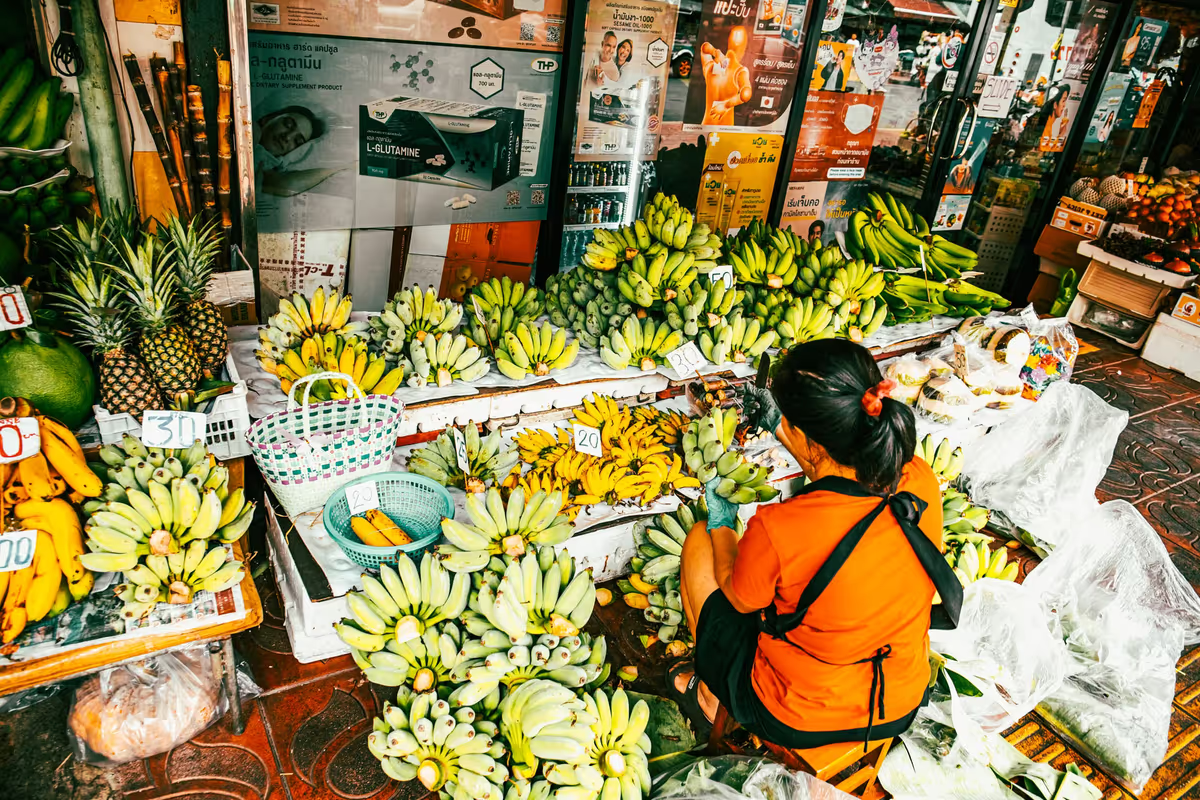
A few small extras save time: ao sai thung duai means put it in a bag, and mai ao thung means no bag needed. Pairing an ni with a pointing gesture settles half of all purchases at a fruit stall.
Now, where haggling does not work: supermarkets, 7-Eleven, pharmacy chains, food courts and any stall with a printed price tag. There 'lot noi dai mai' earns only a polite smile and the same number back. Bargain at street and night markets, in souvenir rows, with boatmen, and when negotiating a longer motorbike rental.
Fruit is often sold by the kilo rather than by the piece. Asking kilo la thao-rai (how much per kilo) clears up most misunderstandings at the scales.
What to say in a taxi to get the meter on
There is one main phrase: poet mi-teu duai krap/kha (เปิดมิเตอร์ด้วยครับ/ค่ะ), meaning 'please turn on the meter'. A second option is chai mi-teu duai (ใช้มิเตอร์ด้วย).
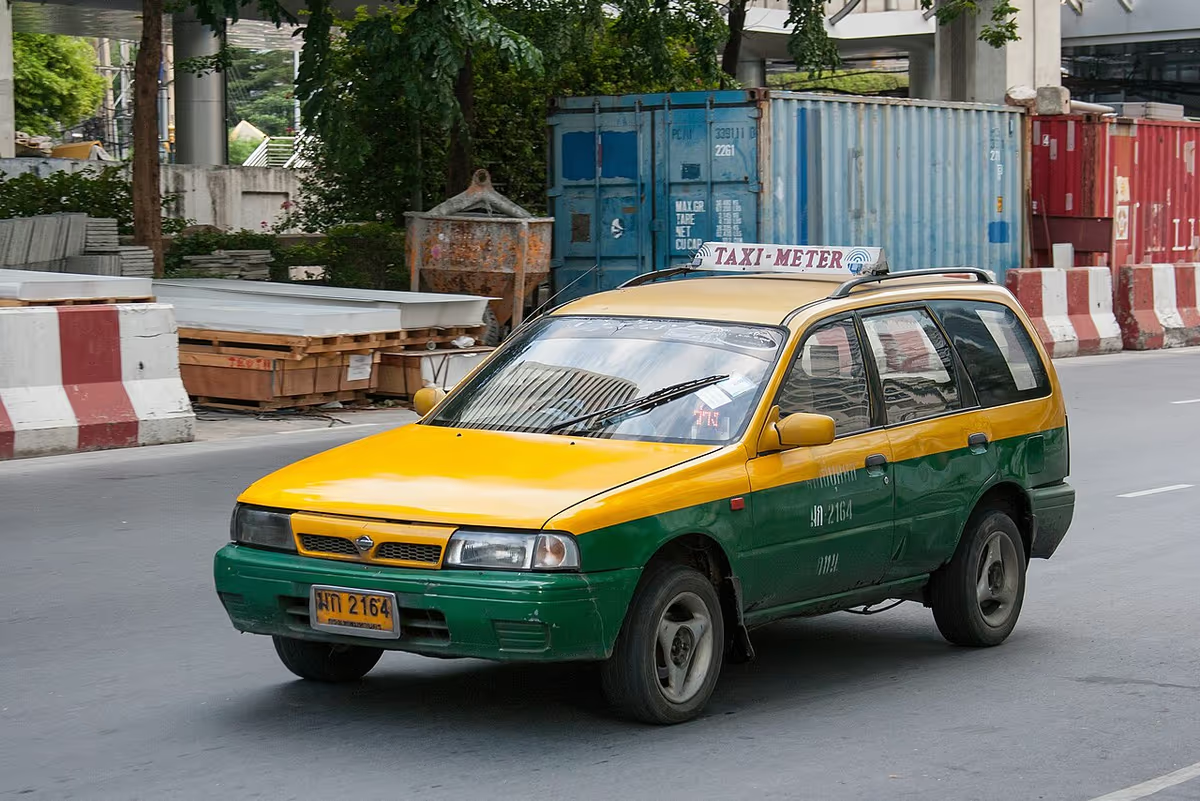
If the driver refuses, do not argue or haggle further. Get out and flag down the next car. It is the fastest fix and works almost anywhere with enough traffic.
A caveat on traffic matters here. At airports and tourist hotspots a fixed tariff applies and no meter is expected at all, so even a perfectly pronounced phrase changes nothing. If you land at night or travel with kids and luggage, it is easier to book an airport transfer in advance than to sort things out at the taxi rank.
Useful phrases once you are on the road:
- pai thi... dai mai krap/kha (ไปที่…ได้ไหม) - can you go to...?
- trong pai (ตรงไป) - straight ahead
- liao sai (เลี้ยวซ้าย) - turn left
- liao khwa (เลี้ยวขวา) - turn right
- chot trong ni (จอดตรงนี้) - stop here
- cha noi - slower, please (needed more often than you think)
- ro sakkru - wait a moment
It is better to show the hotel or street name on your screen in Thai script than to pronounce it. Districts and small sois are poorly recognized by ear even by people who have lived here for years.
At the doctor and the pharmacy: saying what hurts
In the large hospitals of Phuket, Bangkok and Pattaya, English at reception is almost always available. In a small village clinic you cannot count on it. The minimum set:
- mai sabai (ไม่สบาย) - I feel unwell, I'm sick
- puat hua (ปวดหัว) - headache
- puat thong (ปวดท้อง) - stomach ache
- puat fan (ปวดฟัน) - toothache
- pen khai (เป็นไข้) - fever
- phae ya (แพ้ยา) - allergic to medicine
- chuai duai (ช่วยด้วย) - help
- riak rot phayaban (เรียกรถพยาบาล) - call an ambulance
- mi ya... mai - do you have medicine for...?
Pharmacy phrasebooks for Pattaya list the same core pattern: Mee ya... mai? (Do you have medicine for...?) plus the problem word, such as puat hua for a headache, puat thong for a stomach ache, thong sia for diarrhoea and jeb kor for a sore throat.
One habit is worth building before anything hurts: write your allergies, chronic diagnoses and regular medication names in your phone notes, in Thai script. Showing the screen at a reception desk is faster and more reliable than miming. Brand names of drugs in Thailand often differ from the ones you know, but an active ingredient written in Latin letters will be understood at any pharmacy.
Why Thais do not understand you even though you learned the phrase
It is almost never about accent. There are two causes.
The first is tones. The same combination of sounds at a different pitch is a different word, and the familiar Latin transcription (RTGS, the one on road signs) does not convey tones at all. You read 'mai', but that spelling can stand for several completely different words.
The second is aspirated consonants. kh, th and ph in transcription are not the English 'th' or an 'f'. They are ordinary k, t and p with a puff of breath. Phuket sounds closer to 'Poo-ket' than what your eye suggests.
So the fix is simple: keep the Thai spelling of key words and addresses in your phone. Showing the written word beats repeating it louder. Repeating at a raised pitch never helps, because your listener is not deaf, they simply heard a different word.
Speak calmly and in context. At a market, with fruit in your hands, you will be understood even with a crooked tone, because the situation itself supplies the meaning.
FAQ
Can you live in Thailand without speaking Thai?
Yes, especially in Phuket, Pattaya and central Bangkok. But in a hospital, an immigration office, a village shop or a conversation with a landlord, thirty phrases will save you hours and stress.
Krap or kha: how not to mix them up?
Men always say krap, women always say kha. The particle depends on the gender of the speaker, not the listener. The mistake is not offensive, but it is noticed immediately.
What if a taxi driver will not turn on the meter?
Ask once: poet mi-teu duai krap/kha. If he refuses, get out and take the next car. The exceptions are airports and tourist spots with a fixed tariff.
Do I need to learn the Thai script?
Reading is optional. But copying key words and addresses in Thai letters into your phone notes is worth doing for everyone: it is the main working tool in a conversation.
How do I politely decline a pushy offer?
Say mai ao krap/kha and smile. Short, polite, and there is no need to continue the conversation.
How do I say thank you and you're welcome?
Say khop khun krap/kha for thank you and mai pen rai for you're welcome or never mind.
How do I ask for the price at a market?
Use thao-rai krap/kha, then lot noi dai mai to ask for a discount at street and night markets.
How do I call for urgent help?
Say chuai duai for help or riak rot phayaban to ask for an ambulance to be called.
One last practical tip: create a phone note with three blocks, your accommodation address in Thai script, your allergies with medications, and five taxi phrases. It opens in two seconds and works offline.
Source: Thai Pharmacy Phrasebook (wjonnyjames.com)
Ready to invest in Thailand? Our experts will help you find the perfect property.
Let us calculate the full cost of your deal
We will find options with transparent costs and taxes for your budget.
What is your goal?