

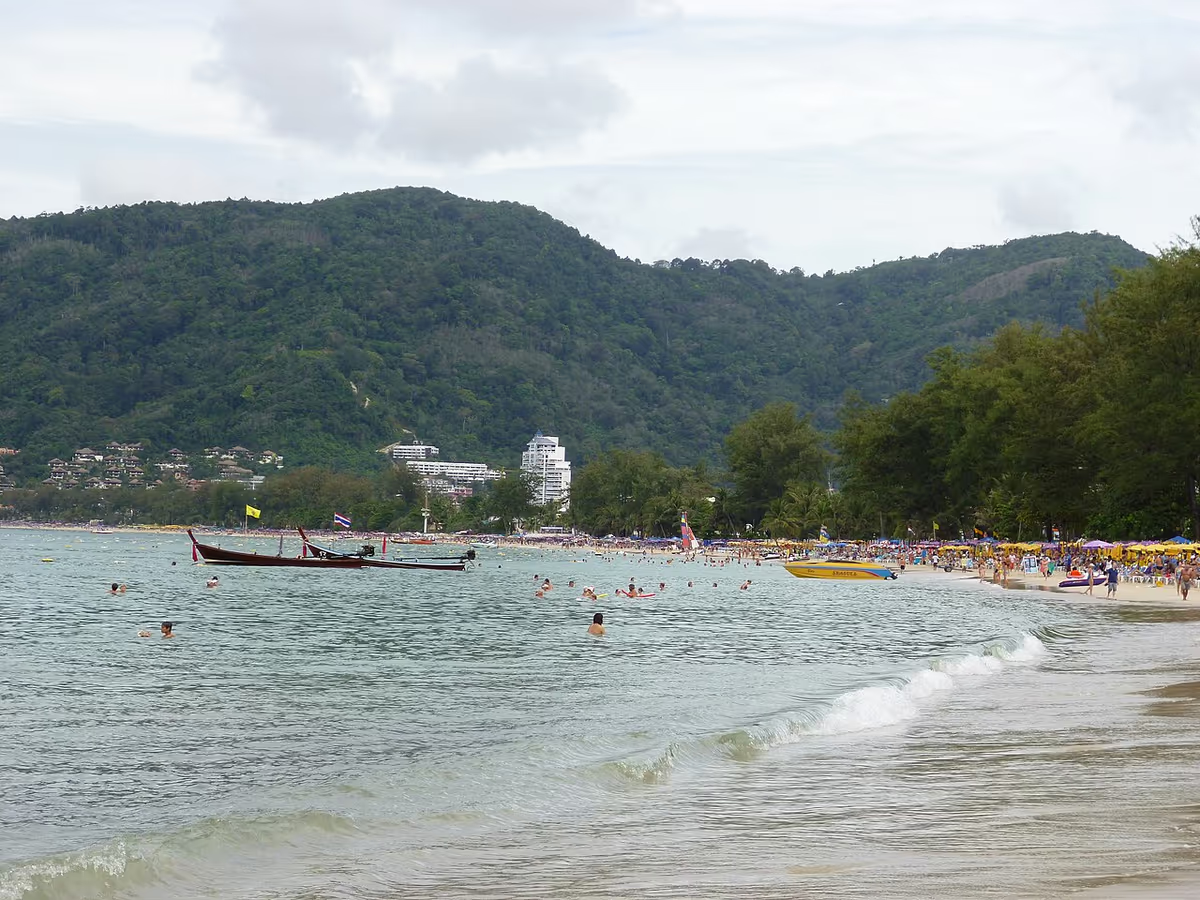
Photo by Dibakar Roy on Pexels
Thailand Mortgage Rejections and Flood Risk: What Property Buyers Must Know in 2026
This material was prepared with the help of artificial intelligence and checked by a person. Editorial responsibility: Aster Of Asia Co., Ltd..
Responsible for content: Leonid Ustinov, Aster Of Asia Co., Ltd.
Aster of Asia editorial team
In late November 2025, floodwater in Hat Yai rose to the second floor. Homeowners who had paid a mortgage on a townhouse for ten years lost their ground floor, car and furniture within a day, while the bank kept charging interest. That single scene explains two forces now shaping Thai housing demand: the buyer's ability to get financing, and the physical vulnerability of the asset.
For an international investor the conclusion is not obvious. You are most likely buying with cash or a developer instalment plan, so a Thai mortgage does not affect you directly. It does affect whoever you will sell to in five years on the resale market. If the Thai middle class cannot get credit, your exit in the segment below 7M THB depends on a very narrow pool of buyers with cash in hand.
Quick Answer
- Mortgage rejection rates in the mass-market segment (homes up to roughly 3M THB) are estimated at 50-70% in 2024-2025, and up to 70% of applications in the lowest price tier are declined. Market-wide the figure is cited at 40-45%. Approval, not the interest rate, is the main brake on demand.
- Household debt sits at around 87-88% of GDP (Bank of Thailand data, 2025). At that level banks cut approvals even when rates fall.
- The policy rate was cut twice in 2025 and reached 1.50%, with almost no effect on transfer volumes.
- Reduced transfer fees of 0.01% (instead of 2% for transfer and 1% for mortgage registration) apply to properties up to 7M THB and are extended to 30 June 2026.
- Flood risk is street-level: a street 15 metres higher up the slope in Patong matters more than any provincial statistic.
Key Facts
- The 2011 floods caused roughly 1.4 trillion THB in damage (World Bank estimate) and still shape insurance terms: flood sub-limits in policies are tighter than fire cover.
- The southern provinces, including Songkhla and Hat Yai, suffered in November-December 2025 what local authorities called the worst flooding in decades.
- Phuket floods from heavy rain rather than rivers: in August 2024 landslides and runoff around Patong and Karon closed roads and damaged ground floors. Island drainage was built for a smaller volume of development.
- Parts of Bangkok are sinking by about 1-2 cm per year while the Gulf of Thailand rises, which works against projects in the low-lying eastern districts.
- Foreign buyers rarely get Thai bank credit. Typical terms are 50-70% LTV, 10-20 years and 6-8% interest, often via offshore branches. UOB Singapore, for example, lends on freehold condos within the 49% foreign quota at 5.5-7.5% for up to 25 years, with a minimum loan of around 3M THB and the borrower aged 65 or under at maturity.
- Foreign ownership in a condominium is capped at 49% of total building area. Units in the Thai quota are cheaper by 10-20% but can only be sold to Thais, so they depend directly on mortgage availability.
- The Bank of Thailand has extended its LTV relaxation to 30 June 2027 for contracts signed from 1 July 2026, which improves financing access in principle.
Why Bank Rejections Hurt More Than Interest Rates
A lower rate helps people who already hold a loan. A new buyer needs approval, not a cheap rate, and approval comes down to debt-to-income ratio, a credit history marked by car-loan arrears, and informal income the bank cannot see.
We will shortlist properties for your budget
Pick a range and we will send a shortlist with prices, layouts and payment plans within 24 hours.
The Thai mass market has relied on buyers earning 25,000-45,000 THB a month. This group took on car loans in 2021-2022 and was hit by the wave of delinquencies. Banks responded by tightening scoring. As a result, mass-market developers collect deposits and then lose 30-50% of deals at the title transfer stage because the buyer fails the bank check.
The practical indicator for an investor is the developer's cancellation rate. Ask for it directly before buying off-plan in any project aimed at Thai buyers. A high rate means part of the supply will return to the market at a discount.
What Did Not Work: Fee Cuts
The 0.01% fee was presented as a market turning point. It was not. On a 5M THB property the saving is around 150,000 THB, which is welcome but does not turn a bank refusal into an approval. The Bank of Thailand's 2025 easing of LTV rules also failed to lift volumes: the regulator lifted limits on second and third mortgages, but the first filter stays with commercial banks, and they did not loosen it.
Until household debt falls noticeably below 85% of GDP, fiscal discounts will remain cosmetic.
How to Check a Specific Property for Flood Risk
Provincial statistics are useless. Four checks work, and all can be done in one day.
- Elevation and slope. Elevation maps are free. A 10-15 metre difference between neighbouring streets in Kamala or Rawai decides everything.
- Ground floor versus road level. If the parking ramp slopes down, the car park becomes a reservoir in heavy rain.
- Drainage channels within 300 metres. A clogged, overgrown concrete channel is a direct forecast for September.
- Neighbours who have lived there for three or more years. The developer will not mention water; a security guard next door will tell you in five minutes.
Inspect in the rainy season, not in January under blue skies. Insurance does not cover everything: a standard condo policy often carries a separate, much lower flood limit, and fit-out and contents need their own cover. Check the wording before signing, not after.
Our View
Projects whose economics depend on the Thai mortgage buyer carry the most exit risk: mass-market condos and townhouses in the suburbs of Bangkok, Chonburi and Hat Yai in the 2-5M THB range. The resale outcome depends on credit recovering, and no one can honestly forecast that.
The more resilient segments are those where the buyer pays cash: Phuket and Samui from 7M THB, resort projects with real occupancy, located above known drainage problem areas. Net yields on completed properties with a track record are realistically 5-7% per year with a management company, below the 8-10% often advertised, but exit liquidity is better.
If you are buying to live in the property yourself, none of this arithmetic matters as much as plot elevation, drainage and how you feel about the location. An open question remains: how quickly insurers will reprice the southern provinces after Hat Yai. If premiums there multiply, the effect on ownership costs could exceed any bank rejection.
FAQ
Can a foreigner get a mortgage in Thailand?
Formally yes, in practice rarely. Thai banks generally do not issue ordinary loans to non-residents. Offshore options exist for freehold condos in the foreign quota, typically 50-70% LTV, 10-20 years (up to 25 at UOB Singapore) at 5.5-8% interest. Most buyers use a developer instalment plan during construction instead.
Is there escrow protection for property buyers in Thailand?
No. There is no escrow mechanism of the familiar kind for foreign buyers of Thai real estate. Protection comes from the payment structure in the contract, tranches tied to construction milestones, and legal due diligence on the developer.
How much do the 0.01% transfer fees actually save?
On a 5M THB property the saving is roughly 100,000-150,000 THB depending on how costs are split between the parties. The measure covers properties up to 7M THB and is extended to 30 June 2026.
Do floods push property prices down?
Locally, yes, and quickly. After a major flood, properties in affected areas sell at a discount and prices take years to recover. Districts with no flood history see almost no effect; the market distinguishes streets, not cities.
Which Phuket areas flood most often?
Problems recur in low-lying parts of Patong, along drainage channels in Karon and Chalong, and near drainage outlets in Rawai. Higher plots in Kamala, Layan and Bang Tao suffer noticeably less.

Is a Thai-quota condo worth buying to save money?
The price is 10-20% lower, but at exit the only buyer is Thai and therefore dependent on bank approval. With current rejection rates this is a deliberate bet on weaker liquidity.
Does household debt affect the rental market?
Indirectly, and in the landlord's favour. The fewer people who pass bank checks, the longer they rent. For owners this supports long-term occupancy in urban locations.
How is flood risk insured in a Thai condominium?
Through a property policy with a separate flood limit that is almost always lower than the main sum insured. The condominium juristic person's building policy covers structure and common areas, but not your fit-out or furniture.
Source: Apartwell
Ready to invest in Thailand? Our experts will help you find the perfect property.
Which payment terms work for you?
We will match properties with instalments and flexible payment plans.
What is your goal?