

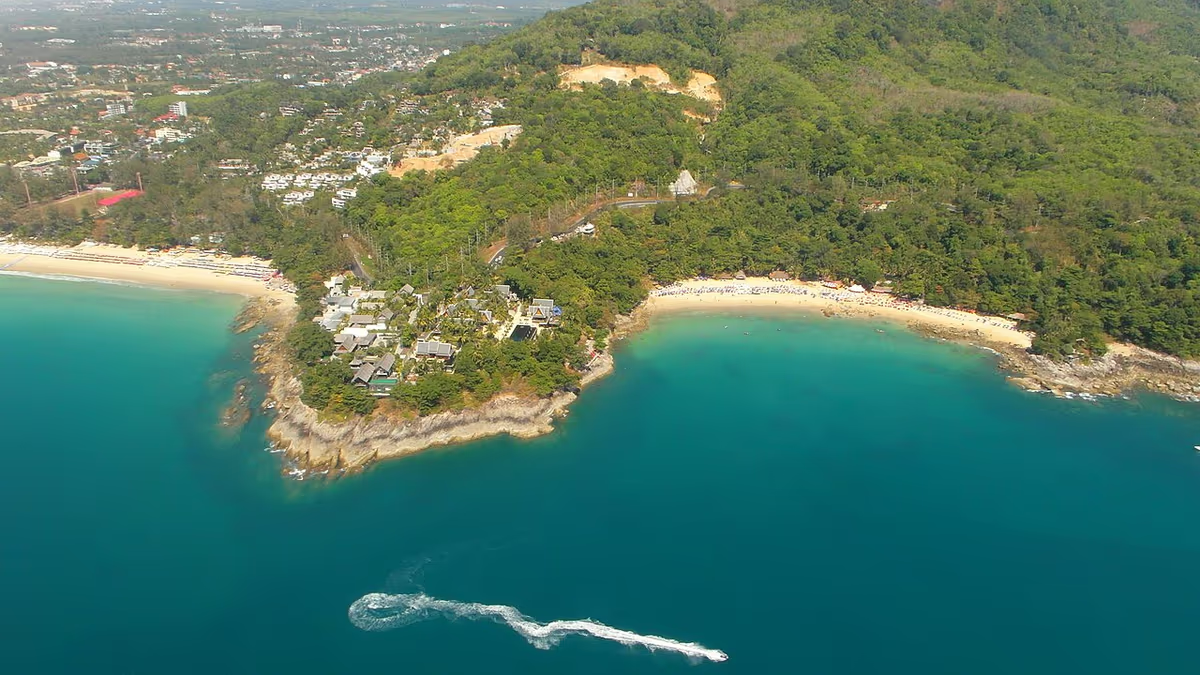
Photo by Blackcurrant Great on Pexels
900 Phuket Hotels Without a Licence: What the 2026 Raids Mean for Investors
This material was prepared with the help of artificial intelligence and checked by a person. Editorial responsibility: Aster Of Asia Co., Ltd..
Responsible for content: Leonid Ustinov, Aster Of Asia Co., Ltd.
Aster of Asia editorial team
On 23 July, an inspection team led by Deputy Interior Minister Polapee Suwunchwee visited five properties in a single day: The Proud Karon and Phuket Moonlit in Mueang, The Charm Resort and Citygate Kamala Resort in Kathu, and The Wood Terrace in Thalang. None of them held a hotel licence. Some operators were detained on the spot.
The direct answer for investors: renting out accommodation in Phuket for less than 30 days without a hotel licence counts as hotel business under the Hotel Act B.E. 2547 (2004), and in 2026 enforcement is arriving in person, with police and provincial administration officers rather than a warning letter.
By current estimates, roughly 900 of Phuket's approximately 3,000 hotel properties operate without a licence, about 30%.
We will shortlist properties for your budget
Pick a range and we will send a shortlist with prices, layouts and payment plans within 24 hours.
Quick Answer
- One test: 30 days. A rental contract shorter than 30 days is a hotel service. Longer than that is an ordinary residential lease and needs no hotel licence.
- Penalty under the Hotel Act: up to 1 year in prison and/or a fine of up to 20,000 THB, plus 10,000 THB for every day the violation continues after an official order.
- Scale: about 900 unlicensed properties out of about 3,000 in Phuket (2026 estimate, counted by property, not by room).
- July 2026: at least 9 properties were inspected across Karon, Rawai, Kamala, Thalang and Kathu. On 29 July, inspectors reached the The Pixels Cape Panwa condominium over short-term letting.
- New in enforcement practice: inspectors now check the shareholding structure of the operating company alongside the licence. In one case, 49% Russian participation was recorded.
- Provincial directive (early July 2026): unregistered hotels and entertainment venues were ordered to file legalisation paperwork within a fixed deadline. The consultation period was partly extended, but the inspection phase has already begun.
The July raids are not the first wave. In June, a special team from the Department of Provincial Administration worked through three properties in Karon and Rawai. The logic is consistent: first a directive with a deadline, then selective visits to the most visible addresses, then expansion into condominiums, where short-term letting is run not by a single building operator but by dozens of private owners.
The local press confirms the broader picture. Bangkok Post reported that five Phuket hotels were temporarily closed for lacking licences or failing requirements, with 40 more under review for licence renewal, some missing documents such as environmental impact assessments or safety certificates. Separately, the Nation Thailand reported that authorities issued licences to 275 accommodation properties in two months, cutting the backlog from 392 applications to 117, which are due to be fully processed by September 2026. In short, legalisation is possible for compliant buildings, and enforcement is rising for the rest.
The share of the illegal segment looks contradictory depending on the source, and it is worth reading correctly. Thai Hotels Association data from 2015 put unregistered rooms at up to 70%. Today's 30% is counted by property. The gap mostly reflects a change in counting method rather than a sevenfold market clean-up: large legal hotels contribute many rooms under one legal entity, while hundreds of small villas and apartment complexes contribute few rooms across many addresses. Some Phuket industry voices argue the true number of small operators is far higher, with Phuket News citing roughly 8,000-9,000 small hotels against only a fraction licensed.
The most uncomfortable detail in the inspection reports: some buildings were originally designed as residential or condominium property and were converted to hotel use without permits. The problem is not a forgotten form, it is the building itself.
Main Risks and Mistakes
The main mistake: assuming the legalisation directive solves the problem
Anyone can file documents. Only a property that physically complies can obtain a licence: access road width, required parking spaces, a second evacuation staircase, fire systems, ceiling height, sanitary facilities. A residential condominium built to housing standards typically fails these points, and no extension of the consultation period changes that.
What to do: commission a technical compliance assessment against the Hotel Act and building codes before buying, not after the first inspection visit. If the building cannot pass, legalisation is spend without result.
Other red flags
- Promised yields of 7-10% per year from nightly rentals in a residential condo. The model depends on a violation. Check in whose name the licence is issued: the whole project, or nobody.
- 51/49 structures with Thai nominee partners. The source of the Thai shareholders' capital is now being examined. Nominee ownership is not a formality, it can constitute a breach of the Foreign Business Act. Mitigation: audit actual capital contributions and company bank flows.
- The operator is detained, not the owner, which is cold comfort. A shutdown hits the unit owner: income drops to zero, bookings are cancelled, and refunds fall on whoever holds the guests' money.
- A short-term letting ban in the condominium bylaws or owners' meeting resolution. It takes one day to check, is ignored for years, and surfaces at the first neighbour complaint. Mitigation: request the condominium juristic person's meeting minutes for the last three years.
- No liability insurance or fire certificates. A guest incident at an unlicensed property means personal liability with no insurance cover. Mitigation: insurers only cover lawful operations, which is itself a reality test of the business model.
- Betting that raids will skip individual villas. The June visits to Karon and Rawai targeted exactly the smaller properties.
Our position: if you own a unit in a residential condominium with mixed ownership, do not spend money trying to legalise it. Move the unit to contracts of 30 days or longer with the term documented in writing, accept a yield 2-3 percentage points lower, and sleep well. There is one significant exception: if the project was built as a condotel, holds a project-level hotel licence and has a management company with a rental pool agreement, nightly letting is legal and none of the above applies to you. A second exception is the very small format: properties with up to four rooms and no more than 20 guests can use a simplified registration regime, which is worth checking before giving up short-term rentals.
For those flying in to view properties: at the height of the inspections, it is sensible to book a hotel at a licensed property rather than an apartment in a residential condo through a private host. A shutdown in the middle of your stay in high season means finding accommodation at triple the price.
FAQ
Can I rent out an apartment in Phuket on a nightly basis?
Not unless the property holds a hotel licence. Any contract shorter than 30 days falls under the Hotel Act. Booking platforms operate freely regardless, so the existence of a listing says nothing about legality.
What is the penalty for renting without a hotel licence in 2026?
Under the Hotel Act: up to 1 year in prison and/or a fine of up to 20,000 THB, plus 10,000 THB per day while the violation continues after an order. Separately, there can be tax claims and immigration reporting issues for foreign guests (TM30).
Is the 30-day rule a legal workaround?
It is not a workaround, it is a different legal category. A rental of 30 days or more is not a hotel service. But the term must be genuine: a chain of two 15-day contracts for the same guest will not convince an inspector.
How do I check whether a hotel or project has a licence?
A Hotel Act licence is issued by the provincial administration to a specific legal entity and address, and a copy must be displayed at reception. The number can be verified with the provincial office. When buying, require a copy of the licence and a company extract for the holding entity, not a verbal promise from the developer.
Is foreign shareholding in an operating company being checked?
Yes. In July 2026, a review of the shareholding structure began for certain hotels, and in one case 49% Russian participation was recorded. A foreign stake of up to 49% is lawful in itself. The questions arise around the Thai 51%: did the partners actually contribute capital, and do they genuinely manage the company?
What happens to my income if the property is closed?
Bookings are cancelled, refunds fall on the operator, and during a suspension the unit sits idle until converted to long-term rental. Guaranteed returns are usually not paid in this situation, since guarantees in contracts are almost always tied to lawful operation.
Can a residential condominium be converted into a legal hotel?
Legally there is a path, but in practice it is closed to most residential buildings because of construction standards and the owners' meeting position. Realistically, only standalone buildings already close to hotel parameters pass, after renovation.
Is it still worth buying Phuket property for rental income after these raids?
Yes, but the selection criterion has shifted. Projects with a project-level hotel licence and a transparent operator win, while residential complexes with informal nightly letting lose. Tighter enforcement hits the shadow supply, which works in favour of those who bought a legal format from the start.
One concrete action for the coming week: request three documents for your property - a copy of the hotel licence showing the number and holder, a current company extract for the operating entity listing its shareholders, and the condominium owners' meeting minutes on short-term rentals. If even one is missing, the income model needs rebuilding before the provincial administration pays a visit.
Source: Bangkok Post
Ready to invest in Thailand? Our experts will help you find the perfect property.
Which area of Thailand suits you best?
We will match properties in locations that fit your goals.
What is your goal?